
Executive Summary: The Shift from Ad Agency to Creative Production House
A creative production house is an integrated partner that combines brand strategy, concept ideation, and full scale production into a single “script to screen” service replacing the traditional fragmented agency vendor stack. In 2026, Singapore marketing leaders are shifting budgets toward this model because it eliminates the 15 – 25% agency markup layer and compresses standard 12 week campaign cycles into 6 weeks. By collapsing strategy and execution under one roof, brands are producing high velocity, social first video content with stronger creative consistency and far better cost defensibility than the legacy agency model can deliver.
Key Pillars of the Production House Shift:
- Markup Elimination: A creative production house removes the 15 – 25% agency markup layer applied to third party vendor work, collapsing the cost stack into a single line item.
- Velocity Advantage: Brands moving to this model report timelines compressed from 12 weeks to 6 weeks and 30 – 50% cost savings on comparable creative output.
- Unified Script to Screen Ownership: The integrated model removes creative dilution caused by handoffs between agency creatives and external production crews what’s pitched is what gets made.
- Singapore Specific Edge: Local crew networks, multi language storytelling across English/Mandarin/Malay/Tamil, and permit logistics are executed natively rather than subcontracted to external vendors.
For most video led, social first, and brand storytelling work in 2026, the creative production house is now the more strategic, cost defensible, and faster moving choice. Traditional agencies remain relevant only for fully integrated 360° campaigns spanning PR, OOH, and global media buying.
Choosing a partner? It’s worth comparing how to choose the right content production house and why the right production company makes all the difference.
What Does a Creative Producer Do?
A creative producer is the role that defines a modern creative production house. They sit at the intersection of strategy, creative, and execution owning the project end to end.
Specifically, a creative producer:
- Translates business objectives into creative concepts
- Writes or directs the script and treatment
- Manages budget and timeline holistically
- Liaises directly with clients without an agency middle layer
- Shepherds the project from first call to final delivery
Think of them as an account director, creative director, and executive producer combined into one accountable role. This consolidation is precisely why the model moves faster than agency teams. To understand how this role looks in practice, meet the team behind our creative production house the same people who lead concepts also lead production on set.
What Is a Creative Production House?
A creative production house is a hybrid studio that owns the entire script to screen service: strategic creative development, concept ideation, scripting, production, and post all in one team.
Unlike a traditional ad agency that subcontracts execution, or a traditional production company that only executes someone else’s idea, a creative production house thinks and makes.
Core Capabilities at a Glance
- Brand storytelling strategy and concept ideation
- Scriptwriting, treatment, and creative direction
- Full production crew, equipment, and on-set direction
- Post production: editing, colour grading, sound design
- Distribution ready outputs for TVCs, social, OTT, and digital ads
This integrated model has gained particular traction in Singapore, where brands need both regional storytelling depth and rapid multi platform execution.
Why Traditional Ad Agencies Are Losing Ground
Traditional ad agencies were built for a different era defined by 30 second TV spots, print campaigns, and 12 month strategic planning cycles.
That structure made sense in 1995. It rarely makes sense in 2026.
1. Layered Markup Stacks
Ad agencies typically mark up production by 15 – 25% before sub contracting work to actual production teams. Brands pay for account managers, planners, strategists and then again for the team that physically makes the work.
A creative production house collapses this stack into a single line item.
2. Slow Turnaround Cycles
A traditional agency campaign often runs 8 – 12 weeks from brief to delivery. Brands operating in real time culture reacting to trends, news cycles, or platform shifts can’t afford that latency.
3. Disconnected Creative and Execution
When the team that thinks the idea isn’t the team that shoots it, things get lost in translation. Costs balloon. Creative gets diluted. Deadlines slip.
A unified script to screen service eliminates these handoffs entirely.
4. Misaligned Incentives
Agencies are incentivised to maximise billable hours and retainer scope. Production houses are incentivised to deliver finished work. The economic alignment with the brand is fundamentally different.
 How a Creative Production House Actually Works
The rise of the creative production house mirrors a broader CMO mindset shift: marketing leaders increasingly want partners who deliver outcomes, not slide decks.
Strategy Lives Inside the Studio
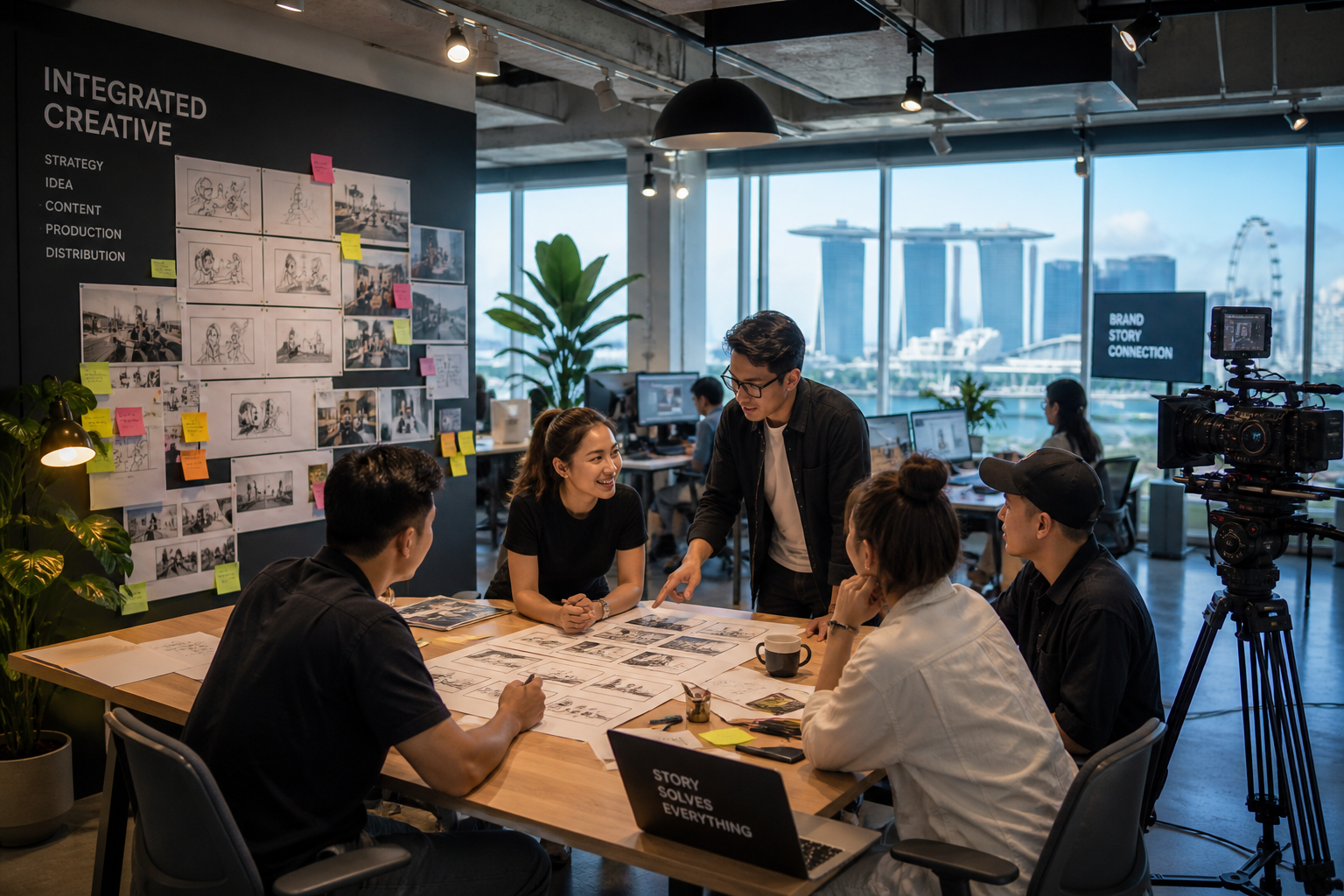
In a creative production house, the strategist sits beside the director. The copywriter collaborates with the editor. Brand storytelling agency thinking is baked into the same room where the lighting setup is designed.
This proximity creates creative tension that pure play agencies can’t replicate because the constraints of production inform the idea from day one.
Faster Feedback Loops
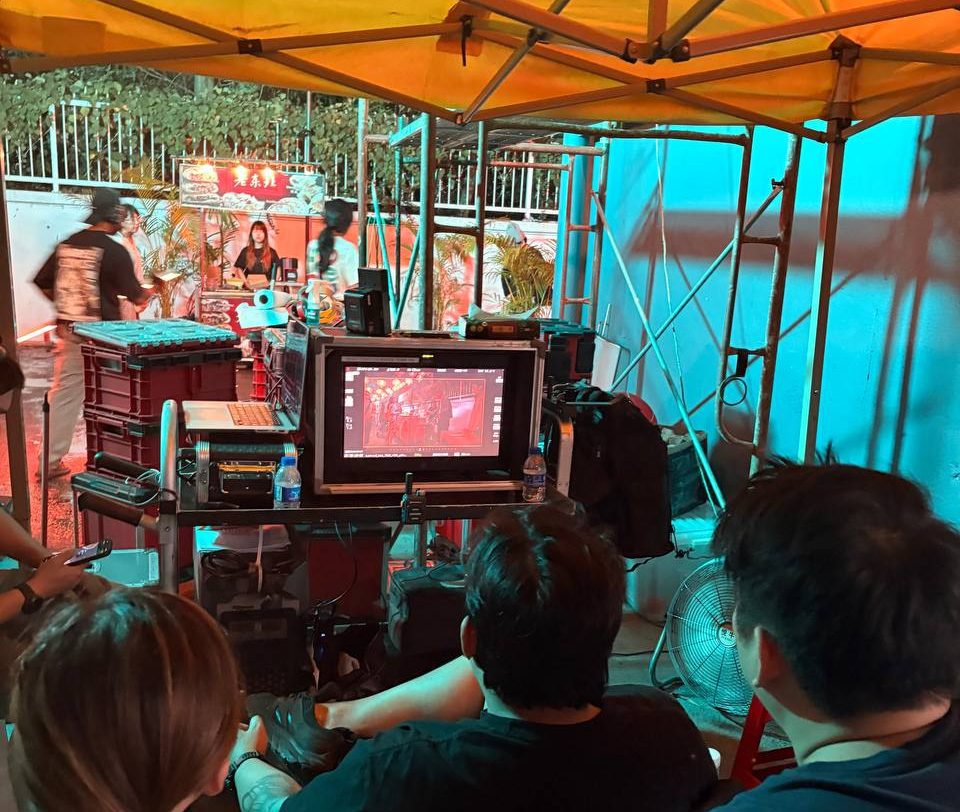
With no agency vendor handoff, revisions happen in hours, not weeks. A client comment on Tuesday morning can be reflected in the cut by Tuesday afternoon.
Cost Efficiency Without Compromise
Without the overhead layer, brands typically see 30 – 50% cost savings on comparable creative output while gaining direct access to the people actually making the work.
 Agency vs. Creative Production House: A Singapore Example
Picture a Singapore based fintech launching a new product. Here’s how the same brief plays out under two models:
| Comparison Metric | Traditional Ad Agency Path | Creative Production House Path |
| Total Timeline | 12 Weeks (Standard) | 6 Weeks (Agile) |
| Workflow | Linear: Brief → Strategy → Pitch → Shoot | Parallel: Brief → Concept/Pre-prod → Shoot |
| Stakeholders | 3 (Brand + Agency + Vendor) | 1 (Brand + Studio) |
| Cost Structure | Multiple invoices + 15–25% markup | Single line item; No markup |
| Revision Speed | Days (via account manager) | Hours (direct to editor/director) |
| The “Hand-off” | Creative & execution are decoupled | Unified script-to-screen ownership |
You may also find this useful: how Singapore production companies create exceptional work.
For a deeper breakdown of what these timelines mean for budget, see our analysis of corporate video production costs, timelines, and ROI in Singapore.
Visual Storytelling Singapore Brands Actually Need
Singapore’s market has unique demands. Brands often need content that works across English, Mandarin, Malay, and Tamil markets and resonates across SEA without losing local nuance.
This is where visual storytelling Singapore production houses pull ahead. They understand:
- Regional cultural cues that global agencies routinely miss
- Local talent networks for cast, location, and crew
- Permit logistics for filming across the city state
- Platform specific norms for TikTok, Instagram, LinkedIn, and OTT in this market
- Multi-language adaptation without losing creative intent
Traditional ad agencies typically subcontract this knowledge. Creative production houses live it daily.
Inside Video Concept Development at a Creative Production House
The phrase “video concept development” sounds simple. In practice, it’s where most projects succeed or fail.
A creative production house approaches it fundamentally differently from an agency:
| Model | Team Setup | Concept Output | Production Awareness | Client Visibility |
| Agency | Strategy team writes a deck; creative team develops concepts on paper | Three concepts presented; client picks one | Production team briefed only after concept is locked | Client sees finished concepts, not the process |
| Creative Production House | Director, strategist, and producer collaborate from day one | Concepts shaped with full awareness of production realities | What’s pitched is what gets made no creative compromise during execution | Clients see treatments, mood boards, and production approach simultaneously |
The result: fewer surprises, tighter creative, and a final product that matches what was sold in the room.
When You Should Still Hire a Traditional Ad Agency
Traditional ad agencies aren’t obsolete. They’re still the right call when:
- You need integrated 360° campaigns across PR, OOH, print, and digital
- Your brand requires deep ongoing strategic planning beyond content
- You’re managing multi market campaigns across 10+ countries simultaneously
- You need media buying bundled with creative
For most other scenarios especially video led campaigns, social first content, and brand storytelling agency work a creative production house delivers better creative, faster, at lower cost.
For guidance on briefing the right partner, see our 2026 marketer’s template for briefing a production house.
Why This Shift Matters for Marketers in 2026
For senior marketers, the choice of creative partner is increasingly a board level conversation. Here’s what’s actually at stake:
1. Speed Is the New Strategy
Brands that publish, react, and iterate weekly will outpace those locked into 12 week agency cycles. Creative production houses are built for this cadence.
2. Authenticity Beats Polish
Audiences in 2026 reward content that feels real. Layered agency processes often sand down the edges that make work distinctive. A leaner team retains the original creative voice.
3. Budget Defensibility
CFOs are scrutinising marketing spend closely. “One partner, one invoice, measurable output” is far easier to defend than a fragmented agency vendor stack.
4. Talent Migration
The best directors, editors, and DOPs increasingly want to work inside creative production houses, not agencies. The talent shift is already underway and it accelerates the quality gap.
How to Evaluate a Creative Production House
Not every studio calling itself “creative” actually is. Use this checklist:
- Do they show original concept work, or only execution reels?
- Is the strategist or creative director in the first meeting?
- Can they articulate a brand storytelling philosophy, not just a portfolio?
- Do they own the script to screen service end to end without external subcontracting?
- Can they show case studies where they led the idea, not just the shoot?
If the answer to most of these is yes, you’re looking at a true creative production house not a production company in costume.
Conclusion: The Future of Brand Storytelling
The ad agency model isn’t dying overnight, but it is fragmenting. The brands winning in 2026 are the ones already moving on partnering with creative production houses that combine strategic thinking with hands on craft.
This shift isn’t a fad. It’s structural. As marketing budgets tighten and content demands accelerate, the integrated, founder led, script to screen model will keep gaining ground.
If your brand still operates on a traditional agency vendor model, the question isn’t whether to evolve. It’s how soon and which partner you’ll evolve with.
To see how a modern creative production house approaches your brand’s next campaign, explore our video production services and let’s start with a conversation, not a deck.
Ready to start your project? Explore our production services.



